
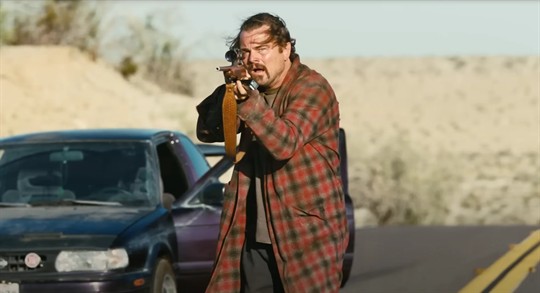
“One Battle After Another” is a modern political manifesto disguised as a crowd-pleasing dark comedy; its craft, vision, and breakneck pace demanding attention from start to finish while leaving viewers with either laughter and spectacle, or the spark of revolution.
Past, present, and future. A complicated web of terrifying implications and inevitable-feeling outcomes, spun by a vague force fueled by hate and complicity shines like a diamond in a coal mine in Paul Thomas Anderson’s latest masterpiece One Battle After Another. Much will be said about the tension Mr. Anderson builds, the wonderful performances he coaxes, and the impeccable timing with which he inserts comedy. But I want to focus on the use of time to inform social commentary.
The film opens with a violent revolutionary action, then jumps 16 years and runs the rest linearly. That skip allows the audience to measure how little has changed societally in that time. The world is still violent toward immigrants; that violence is still met with political activism and, at times, political theater. Mr. Anderson uses this single time jump to illustrate the futility of Bob’s (Leonardo DiCaprio) activism and to address (often comedically) the rate at which life outpaces measurable societal change.
Staying in the present without constantly looking backward keeps the politics front and center. This maintains the tension: rather than contemplating the futility of activism in the abstract, the audience is forced to reckon with the immediate need to do something, regardless of the outcome. You can see this in the more performative activist qualities of Bob’s daughter Willa’s (Chase Infiniti) friends. Even if their activism lives more on social media than in the real world, they still have opportunities to affect Willa’s fate by withholding information. It’s a simple act, but activism nonetheless. The present-tense approach, coupled with an unchanging social landscape, keeps the politics relevant and fresh.
“What time is it?” is a running gag. Just when Bob needs the foundational support of the political movement he helped build, he’s confronted with a question he can’t answer to prove his identity to someone who already knows him. The bit skewers performative activism (virtue signaling), but it lands deeper when Willa later forces him to answer. This is a literalization of time and a generational handoff of activism. The point is to be “on time” with the movement instead of stuck in yesterday’s heroes.
The duration also underlines the thesis: the fight is exhausting because it is continuous. At over 160 minutes, One Battle After Another is a commitment. It’s a declaration. It’s saying, “prepare yourself, because this won’t be easy.” Like a bullet from a gun, Mr. Anderson throws the audience into a whirlwind – a propulsive tempo that mirrors a country where raids, deportations, military convoys, and back-room deals never stop. It’s a fictional world (for now), and from the outside looking in, it’s hard to deny that it’s exhilarating – runtime and all.
Paul Thomas Anderson’s use of time to inform social commentary is as expertly executed as any of the technical elements that combine to make One Battle After Another genius. It’s what makes this particular work feel so special. Above all else, it helps explain why he’s earned the favor of critics and cinephiles the world over, and it’s elements like these that will certainly keep me buying whatever he’s selling next.

Leave a Reply